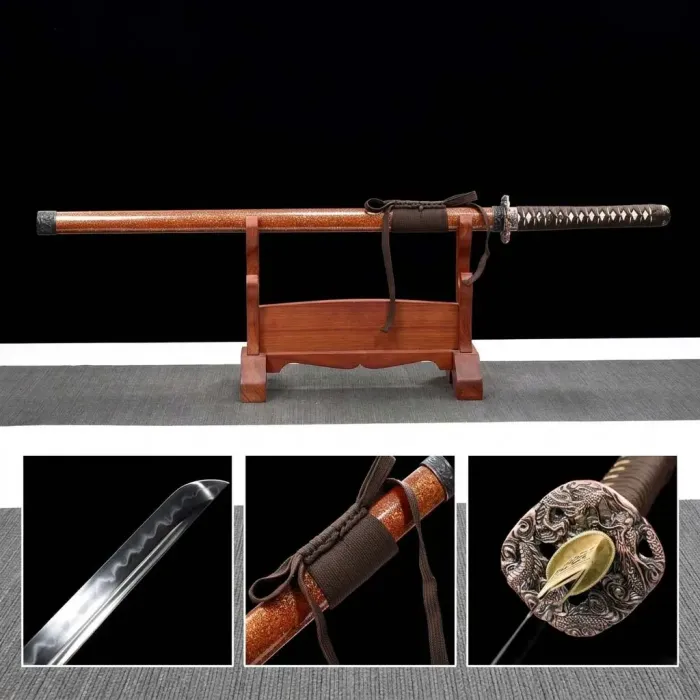
This conventional oriental sword stands a magnificent display of technique, but say you want to manifest your personal design? Modifying your cutting tool is a deep journey, allowing you to construct a truly one-of-a-kind piece. From the shaft wrapping and sheath to the handpiece design and marking, each feature offers a chance for personalization. This examination delves into the field of katana alterations, providing knowledge for both rookies and skilled enthusiasts searching to form their legacy on the long-standing art of the samurai.
1060 Steel Katanas: The Beginner's Legitimate Skill
For those hoping to embark on the enriching journey of traditional blade practices , 1060 steel katanas supply an remarkable entry point. This specialized grade of structural steel achieves a ideal mix between low price and quality . While less than hard as superior-grade steels, 1060 provides a adequate level of edge development , making it perfect for newcomers to acquire the foundations of blade preservation and appreciate the elegance of handcrafted Japanese weaponry. It’s a excellent choice for acquiring experience without the capital burden of more high-grade steels.
Ten Ten Steel Sabers : Harmonizing Functionality and Expense
Providing for connoisseurs seeking an authentic cutlass experience without overpowering the capital constraint , T10 substance katanas represent a beneficial option. These instruments offer a substantial improvement in strength compared to budget alternatives, exhibiting fair edge retention and suitable flexibility for introductory cutting techniques. While not rivaling the exquisite characteristics of ultimate steels like T100 or folded element , T10 provides a commendable blend of utility and cost-effectiveness , making them a common choice for beginners and those on a modest salary .
Exceeding the Sword : Personalizing Your Katana's Enhancements and Shaft
Despite the honed sharpened metal is undeniably the key point of a katana, truly amplifying its aesthetic lies in the meticulous customization of its features and haft . This art allows individuals to exhibit their individual style . Review the wide possibilities: menuki - decorative appliqués that bring visual interest ; the hamon protective covers – often carefully engraved ; the tsuka nucleus itself, wrapped in traditional ito rope ; and the fusa butt cap , which can be fabricated from various elements like valuables or ivory .
- Select designs that resonate with you.
- Explore with varying resources .
- Emphasize strength for a lasting influence .
The Magnetism of the Katana: Background, Fabrication, and Iron
Every samurai blade features a special allure, steeped in periods of Pacific Rim history and heritage . More than merely a artificial item of skirmishing, it's a embodiment of the soldier ethos – a fusion of skill and restraint . Its maturation spanned score generations, with early steel evolving into the polished curvature and precise edge we recognize today. The creation involved is truly amazing , requiring eons of apprenticeship to attain . The process involves a complicated folding of pure iron , creating layers that amplify the metal’s flexibility and incising ability. Several schools of processing developed , each with their individual secrets and styles for achieving the finest harmony and cleanness - a truly heavy pursuit.
- Early Katana shapes
- The purpose of the samurai blade in fighter class culture
- Time-honored manufacturing procedures
Identifying the Fitting Steel for Your Katana Project: 1060 vs. T10
Choosing the right steel is critically important for any sword project, and the choice between 1060 and T10 can be complex. 1060 is a common American metal, offering a decent balance of strength and toughness, making it relatively easy to condition. However, T10, a Asian steel, habitually boasts amplified wear fortitude and can likely achieve a enhanced conclusive hardness, although it can be markedly troublesome to handle and requires precise heat refinement. Consider your qualification and preferred effects: for a first-timer, 1060 may be a easier origin, while the expert smith might admire the supplementary attributes of T10.
- Simplicity of Utilizing
- Resistance
- Definitive Durability
Opening the Possibilities: Elite Katana Enhancement Procedures
Refining the technique of katana adjustment extends far beyond basic polishing. Serious smiths are now researching advanced techniques to truly activate a blade's hidden potential. This includes intricate work with the heat signature, utilizing specialized ingredients for differential tempering and carefully opting for the form of the tsuba to optimize balance and quality. Beyond purely functional modifications, artisans are increasingly focused on realizing unparalleled aesthetic style, through complex etching and layered films that truly transform a katana into a creation.
From Elemental Metal to Artistry: Forging a 1060 Blade
The journey embarks with typical 1060 substance, a resilient material far lacking the elegant katana it will develop into. Expert bladesmiths perform a complicated process of uniting and molding the initial steel, repeatedly warming it and forging it to remove impurities and develop a symmetrical grain structure. This laborious process, often persisting for days , builds the required force and pliability characteristic of a bona fide Japanese edge . Additional custom katana heat applications , including careful hardening and annealing , are necessary to achieve the expected equilibrium of sharpness, endurance and loveliness .- Uniting: Eliminates impurities and produces grain structure.
- Fabricating: Shapes the steel into the initial blade form.
- Annealing: Establishes the final hardness and flexibility.
The Lasting Drawing of the Katana: An In-Depth Look at Metal and Personalization
This venerable katana holds present a compelling symbol of Japanese heritage , its fascination far outshining mere artillery . Forged from select steel and usually featuring intricate designs , the process of creation itself is a respected art. Beyond the core craftsmanship, the ability to tailor a katana - from the quench mark to the haft wrapping and fitting - affords for a honestly individual demonstration for both worshippers and participants alike. This confluence of classical steelwork and boundless personalization creates the katana's continued widespread acceptance across the universe.